
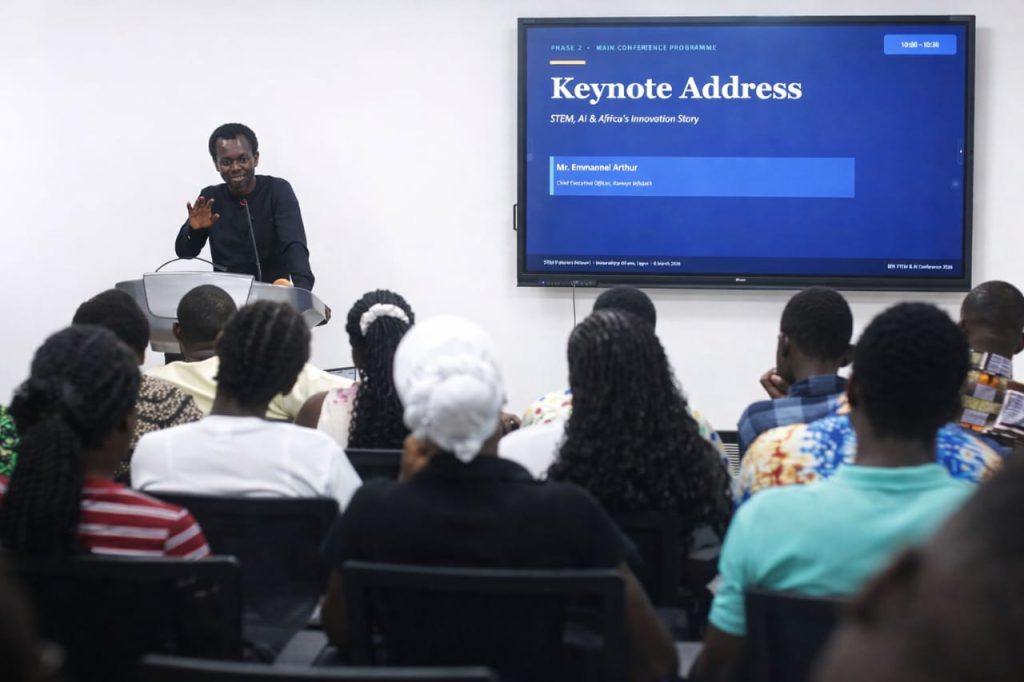
Africa has always been a continent of creators. African creators and inventors built systems of irrigation, textile traditions of breathtaking complexity, and medical practices that predated the formalisation of those same ideas in Western science. That history is not a curiosity — it is the foundation from which every generation that follows has a right to build. It took a single sentence at the SEN STEM and AI Conference 2026 to bring all of that into sharp focus.
Think About the Last Twenty Minutes of Your Morning
The alarm clock that woke you up was created. The mattress you rolled out of was engineered. The light switch you flipped was invented. The water running from cold to warm as needed was designed by individuals who identified a problem and built a solution. Before you went outside your door or spoke to anyone, hundreds of acts of creation had already touched your life. Most of us never stop to feel grateful for any of it.
At the SEN STEM and AI Conference 2026, held at the University of Ghana, Legon, keynote speaker Emmanuel Arthur — CEO of Ramsys InfoTech Solutions Ltd — said something that paused the room:
| “We owe our very existence to creators and inventors.” — Emmanuel Arthur, CEO, Ramsys InfoTech Solutions Ltd — SEN STEM & AI Conference 2026 |
It was not a motivational phrase designed to generate applause. It was a statement of reality — and the more you sit with it, the more extraordinary it becomes.
Everything Around You Was Built
Think of medicine. The treatment that cleared an infection you had as a child. The vaccine that kept you from contracting a disease that killed thousands before it was controlled. The surgical technique that saved someone who would not otherwise still be here. None of this appeared from nowhere. Someone — usually many someones, working across decades — made it. They failed, revised, tried again, and eventually handed us something that became so ordinary we forgot it was ever invented.
Now consider the road you take to work or school. The bridge that shortened a journey that used to take half a day. The phone that lets you navigate, communicate, and read this article. These are not natural features of the world. They are the accumulated labour of people who looked at a problem and decided it was theirs to solve.
African Creators and Inventors Have Always Existed
This is not a Western phenomenon. It is a human one — and Africa’s contribution to it is not a footnote.
The kente cloth worn to a family gathering has interlocked patterns engineered by weavers who understood geometry before it had a Greek name. The fermented foods your grandmother prepares are the work of a biochemist who learned from her grandmother. The irrigation systems built by earlier generations to water crops across dry seasons were civil engineering — without a degree or a textbook in sight.
Africa’s record of creation is long. According to WIPO data, Africa currently generates just 0.6% of global patent applications — not because African creators and inventors are absent, but because the systems that allow individual talent to reach the world at scale have historically been missing: functioning labs, teachers who reward experimentation, policies that protect ideas, and funding that outlasts political cycles.
The Systems Question
Africa has always been a continent of creators. The debate was never whether Africans could invent. The debate has always been whether we have built the infrastructure — the schools, the funding, the mentorship, the recognition — that takes invention from a single person’s idea to something that changes lives at scale.
That is what the SEN STEM and AI Conference 2026 was about. That is what the conference theme — From Consumers to Creators: Changing Africa’s Innovation Story — challenges every person who heard it to become part of.
What This Means for You
If we owe our existence to those who came before us and chose to build, we owe something to those who come after us. Not just gratitude — contribution. The work of becoming a creator is not reserved for geniuses, for people with the right degree, the right background, or the right connections. It begins with a decision: to look at the world around you and take it seriously enough to want to improve it.
Someone, somewhere, will one day owe their existence to what you build. That is not a burden. That is an invitation.
The SEN Innovation Challenge 2026 Is Open
The SEN Innovation Challenge (SIC) 2026 is open to all tertiary students with an idea worth developing. Teams of two to five students. STEM-based solutions to any community challenge. Two bootcamps, structured mentorship, and a Deal Room presentation to stakeholders.
Visit sen.youth-arise.org/sic to register your team and learn more.